Shot Down and in the Drink by Graham Pitchfork
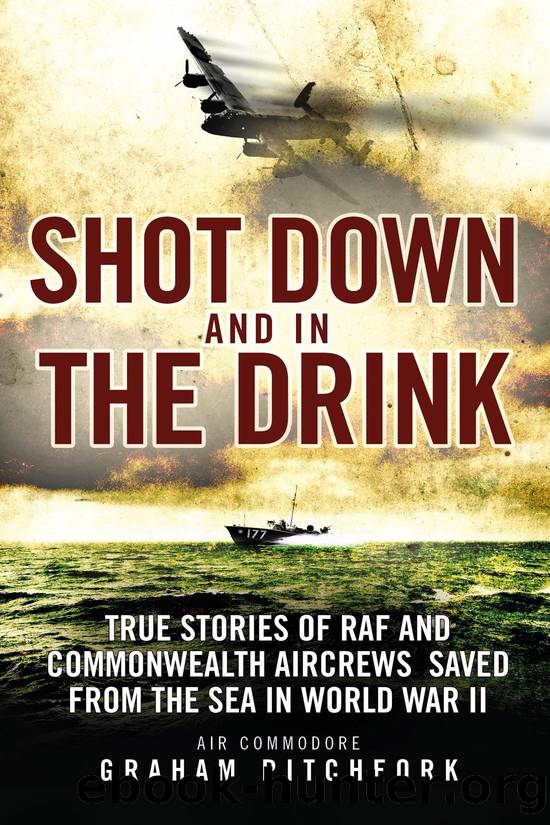
Author:Graham Pitchfork
Language: eng
Format: epub
ISBN: 9781472827265
Publisher: Bloomsbury Publishing
A MODEL RESCUE IN SEVERE CONDITIONS
Just before midnight on 5 January 1944, a 626 Squadron Lancaster (ME 577) took off from Wickenby, near Lincoln, to attack Stettin, a target at very long range even for the best of the RAFâs four-engine bombers. Captain of the Lancaster was Australian Flight Lieutenant Noel Belford. The outbound journey was uneventful and the 4,000 lb bomb and incendiaries were dropped over the target four hours after take off.
Four hours into the return journey, the wireless operator, Sergeant T.S. Trinder, requested a MF/DF fix, which placed the bomber off the Danish coast. Over the next hour a series of bearings and fixes was passed to the aircraft as it crossed the North Sea. At 9 am Belford descended to 8,000 feet, and his crew started to jettison all loose items as it became clear that the aircraft was running out of fuel and would have difficulty reaching the English coast. Ten minutes later, Trinder passed an SOS with the aircraftâs position and the possibility that the aircraft would have to ditch. The navigator, Flight Sergeant Arthur Lee, passed a continuous stream of positions to Trinder who continued to transmit them, allowing the Group Headquarters to keep a constant plot of the aircraftâs progress.
At 9.30 am Trinder passed a further message that the aircraft had fuel for another 25 minutes. The captain then asked all the crew to repeat the ditching drill before they took up their positions. At 9.43 am âSOS, Aircraft Ditching 53.31N 01.29Eâ was transmitted, after which Trinder screwed down his transmission key. The ground station obtained a fix 30 miles to the east of the aircraftâs estimated position, and 3 minutes later, the plot ceased.
It being daylight, Belford was able to assess the sea conditions, which could best be described as bad. There was a very strong wind (30â40 mph), a heavy swell and a rough sea. He decided to ditch into wind although this was across the swell. He made a powered approach and endeavoured to land tail down. However, the swell was so deep that the nose still ploughed into the crest of the swell and the fuselage split just ahead of the bomb doors. The crew were all in their ditching positions, having discarded their parachute harnesses, and the four in the rear of the aircraft scrambled clear. The two gunners suffered minor injuries and the pilot smashed his face against the control column, but they were able to escape from the aircraft and all seven men inflated their Mae Wests.
The dinghy inflated inverted and started to drift away. It was grabbed and the crew turned it over and boarded it, but the sea was so rough that some of the emergency kit was lost during the transfer. One emergency pack was retrieved and the bomb aimer, Sergeant John Lee, took a parachute. The dinghy floated away quickly and 45 minutes later, the Lancaster was no longer visible. The crew used their flying helmets to bale out the dinghy and the parachute was used as a very effective weather apron.
Download
This site does not store any files on its server. We only index and link to content provided by other sites. Please contact the content providers to delete copyright contents if any and email us, we'll remove relevant links or contents immediately.
| Civil War | Operation Desert Storm |
| Veterans | Vietnam War |
The Radium Girls by Kate Moore(12097)
100 Deadly Skills by Clint Emerson(4975)
Rise and Kill First by Ronen Bergman(4842)
The Templars by Dan Jones(4740)
The Doomsday Machine by Daniel Ellsberg(4558)
The Rape of Nanking by Iris Chang(4267)
Killing England by Bill O'Reilly(4045)
Stalin by Stephen Kotkin(4010)
Hitler in Los Angeles by Steven J. Ross(3982)
12 Strong by Doug Stanton(3583)
Hitler's Monsters by Eric Kurlander(3389)
The Code Book by Simon Singh(3255)
Blood and Sand by Alex Von Tunzelmann(3243)
Darkest Hour by Anthony McCarten(3164)
The Art of War Visualized by Jessica Hagy(3048)
Hitler's Flying Saucers: A Guide to German Flying Discs of the Second World War by Stevens Henry(2778)
Babylon's Ark by Lawrence Anthony(2722)
Tobruk by Peter Fitzsimons(2565)
The Second World Wars by Victor Davis Hanson(2555)
